
[ad_1]
 Get the paper!
In this study we sought to understand habitat selection and avoidance behaviors of female greater sage-grouse raising young in an oil and gas field. To accomplish this, we fit GPS transmitters on female sage-grouse that gathered high-frequency location data. We wanted to understand how females raising chicks responded when they encountered various infrastructure and converted habitat while trying to provide the resources their chicks need to survive and avoiding the threat of predation of themselves s and their chicks.
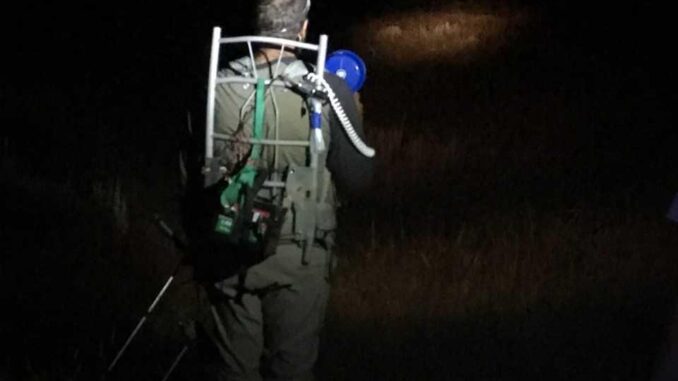
Greater sage-grouse are notoriously good at hiding their chicks in the day because sage-grouse chicks blend in thoroughly with their surroundings. Therefore, it is very difficult to know when tracking her in the day if a female sage-grouse still has her chicks. For our research objectives, it was critical that we knew with certainty that hens in our study successfully raised their chicks to an age they could live independently. To gain this certainty, we tracked our transmitted hens at night and spotlighted them to determine if the hen was roosting with chicks about six weeks after she hatched her nest. Female sage-grouse actively brood their chicks at night and often you will find some of the chicks tucked under the female’s wings. In our study, we found females that we were sure still had their chicks that were not with chicks when we spotlighted them and we found others that we thought had lost their chicks but were surprised to find chicks tucked under the female’s wings when we spotlighted her.

We found that hens with chicks demonstrated a strong avoidance of powerlines and oil and gas reservoirs, both of which are widespread in the study area. We did not detect any avoidance behavior of 3 m tall gas well structures. We found that brooding females were spending most of their time in sagebrush cover and not using disturbed surfaces, such as roads, and reclaimed surfaces such as pipeline corridors. Older hens were showing stronger avoidance of infrastructure and converted surfaces than first-year hens. Our research will inform mitigation actions, such as the importance of burying powerlines, and reclamation when the oil and gas field is at the end of its life.

Categories:
Comments
[ad_2]
Source link
Leave a Reply